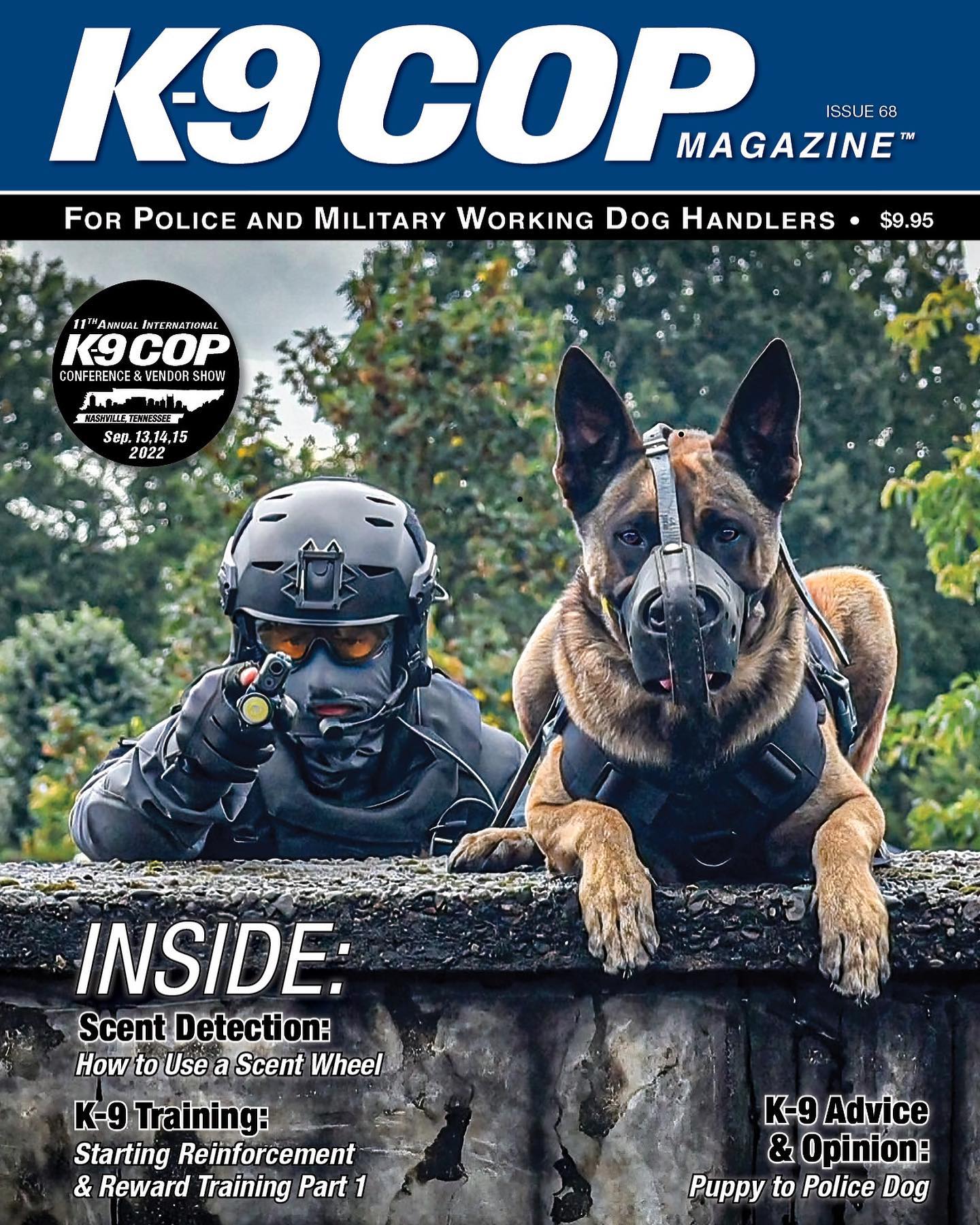
His latest wo
Questions related to obedience training continue to occupy the minds of many
handlers and trainers within the Police K-9 Community. What does obedience training represent ? Should you let things develop on their own with little interference as to not suppress the drive of your dog ? Is training a learning based exercise ? While are some handlers successful and others struggle and fail when using the exact same methods, devices etc ? What is the role of certain devices ? Without a doubt many K-9 Trainers and handlers have debated and invested time into finding answers to these questions.
For me these questions sent me on the journey that would cause me to question everything. The relationship I had with my first Police K-9 “Reuben” was to become the foundation to source out not only the problem but also the key to finding the answers. I knew right away that something wasn’t aligning for many who adopted learning and with motivating responses once behavior issues were already ongoing. Dogs were getting the blame. I knew something wasn’t adding up and that the human was to blame.
One thing I learned right away is that appearances can be very deceiving. Especially when it comes to the dog training world and the very popular idea of what training represents. Appearances have caused much confusion on both sides of the blue line. While Police K-9 Officers are somewhat insulated from the negative outcomes associated with the outside forces of learning theory they have the very real potential of causing problems for the K-9 Handler and team. The lack of insight into what the source of the problem really is keeps the door open for a wide rage of issues associated with a relationship issue between handler and dog. While many K-9 Handlers and Trainers stick to a “formula that works” based on experience its does not eliminate these questions and potential problems associated with a intuitive process.
I understood this very clearly once I continued my journey with helping the average pet owner. This was both a challenge and opportunity to better identify the source of the problem. During this journey I came alongside a behaviorist who was very willing to allow me to put learning under the microscope and to the test. This only confirmed my suspicions. Responses could not be trusted and the end point via positions should not be the focus. Certain concepts such as counter conditioning were also problematic based on the context of agreeableness. A parent can gain the agreeableness of a selfish child to be accepting and
respond via negotiation, accommodation and bribery but it doesn’t represent that the overall relationship is actually getting better.
The problem and rub is with trusting that responses are aligning the right way when the relationship is already going sideways once a dog has already gained control within the relationship. The superficial way in which many trainers jump into a relationship problem and with how they motivate dogs to respond often translates into problems for many dogs and owners. When does motivating a dog to respond cross the line and become bribery is the question that continues to challenge many. The answer can be found when considering the parent and child example. Once a child becomes selfish their motives and perceptions change while behavior issues escalate. To assume that response automatically represents that perceptions are changing is to ignore the depth of what is happening beyond appearances. While quadrants have become accepted by many as the vehicle on which to build a picture the inherent problem is the starting point itself. Motivating a already selfish child to make their bed and pick up their toys may represent good responses however one must connect the dots properly.
The way in which learning is being applied, marketed and used as a standard within the framework of response is the source of the problem within the dog training world. Lack of depth while ignoring how perceptions are influenced socially via the human create this disconnected counterfeit picture for many. Unresolved behavior problems continue to frustrate owners even as dogs respond and look great via the sit, down, come and stay. While the word “behavior” is often used as a dog is responding alluding to perceptions changing the reality is often very different. Appearances and assumptions become the focus. Handlers and Trainers can find themselves in this same trap if they are not aware of certain dynamics that follow the path of this popular idea and approach. Focus shifts. Performance is impacted. Dogs can get washed out needlessly. Time and money wasted. Liability issues. For a larger department they can absorb these issues. It may mean the end for another. Once a dog has already gained a level of control within the relationship than the focus of the dog shifts. Just like the focus of a selfish child shifts.
This can directly impact task associated training and the overall success of the K-9 team. Examples of this can be seen during the track with the dog lifting their head to shortcut while visually scanning to locate the quarry in eager anticipation of getting a bite instead of investing in the scent. This short cutting represents the handler being faded out of the relationship picture at a level which is problematic to the overall success of the team. Getting the dog to take full advantage of its natural abilities is critical. This fade out issue can also be seen with a dog refusing to release the bite on command. This can create a liability issue for not only the team but the program as a whole. Stress and reactivity becomes another issue that follows the path of a dog gaining control in the relationship. While often resolvable with the right approach many dogs get washed out as a result. Just like a selfish child comfort is not found in the right parenting approach. Reversing course follows the path of a intervention with the focus more on the human than dog.
The narrative that obedience training has the potential to suppress a dog’s drive was born from the confusion that follows the path of a superficial idea and process.
Allowing the dog to always get the bite as not to inhibit the dog’s drive is one of the counter measures that has been deployed by those taken down by this confusion. This follows the drive based approach with deciding to not bring “disciple, punishment or corrections” into the equation until a certain point of a dog’s development. This hesitation to disciple and correct a dog comes from the confusion of what obedience represents as a whole. When considering the parenting example the confusion can be sorted out with defining what influence represents as well as its role. Being invested, dialed in and proactive in the relationship as you “interact” in “meaningful” ways to establish parental “influence” with your child. You would not wait until the child is 8-9 years old before deciding to bring your child under influence for fear of discouraging them etc. This delay can create the opportunity for a relationship problem with a dog gaining a level of control within the relationship and the issues that come along with that.
Within the developmental process and relationship of the handler and dog the focus is on a interaction based approach to establish focus which seamlessly transitions into task specific training. Once the perceptions of the dog have changed the right way than motivating responses is no longer an issue. It is time to connect the task associated dots. When a dog has gained a level of control in the relationship reversing course follows the path of an intervention vs a learning based exercise. Again using the parenting example as a reference point the parent needs to come into agreement with the right parenting style while “interacting” with the child in meaningful ways.
The question that every K-9 Trainer and Handler needs to ask is “Is training really a learning based exercise ?” Certainly not the way this idea is being applied within the dog training world and once a dog has already gained a level of control in the relationship and their perceptions has changed. When the process is wrong than the focus and blame will shift onto the dog as the problem. It is the way it must go down. This idea restricts and limits the true potential of the K-9 Team. Ultimately as a Police K-9 Handler and Trainer the question is how can I achieve the very best result ? The goal should be to be set free from anything which holds back the true potential of the K-9 team. The following are just some of the obvious benefits of adopting a process which follows the right relationship path between handler and K-9: Save Agency time and money Need to wash out dogs greatly reduced The highest possible level of focus ( the right way) on the handler which transfers to tasks
Reduced liability issues connected to use of force / increased control / response
Higher success rate
Save lives when seconds matter
My encouragement for the K-9 team is to take hold of this information and re-visit what is possible. Allow it to Ignite a spark which moves your team and program forward. Without a doubt K-9 Officers have the best job in the world. Of course perhaps I am just a little bias.
The above information is available in more detail via
Going to Ground – Police K-9 Trainer Foundation Course
http://www.k9pack.com
About the Author

Dale McCluskey
Retired Police K-9 Trainer and Handler
Over 30 years experience training dogs
Author of
Beyond the Leash – Dog Psychology Training Guide
Going to Ground – The Methodology of Police K-9 Training
Tracking through Pack
Mind and Body Kinetics – Training Guide
.

